Sustainable business mobility

Hello work-life balance: Mobility can now do both

Mobility is changing – both for private use and at work. That’s why Mobility improved its offer for business customers in 2025 and made car sharing even easier. This benefits companies and employees alike.

Woman in red suit leaning against the wall of the house next to a Mobility car sharing vehicle in the city.

Thousands of companies use Mobility for their business trips, thereby contributing to sustainability. Until now, however, employees had two separate access points for business and private use. Anyone who wanted to switch between them had to log out and log in again. This is cumbersome and no longer in line with current standards.

Mobility has taken this as an opportunity to fundamentally overhaul its business offer 2025. Business and private journeys can now be processed via a common access point – with billing and data clearly separated.

Shared cards are a thing of the past

Until now, many companies used Mobility with transferable cards. These were not assigned to a specific person, but were shared within the company. Anyone using a vehicle took the card with them and returned it afterwards. This model was workable for a long time, but it also had practical limitations. Journeys were difficult to assign to individual people and security requirements could therefore only be implemented to a limited extent.

This is now changing. Mobility has been gradually replacing its shared cards with personal access since summer 2025. In future, every user will have their own account. In this way, business journeys can be clearly attributed, while utilisation remains clear and traceable for companies.

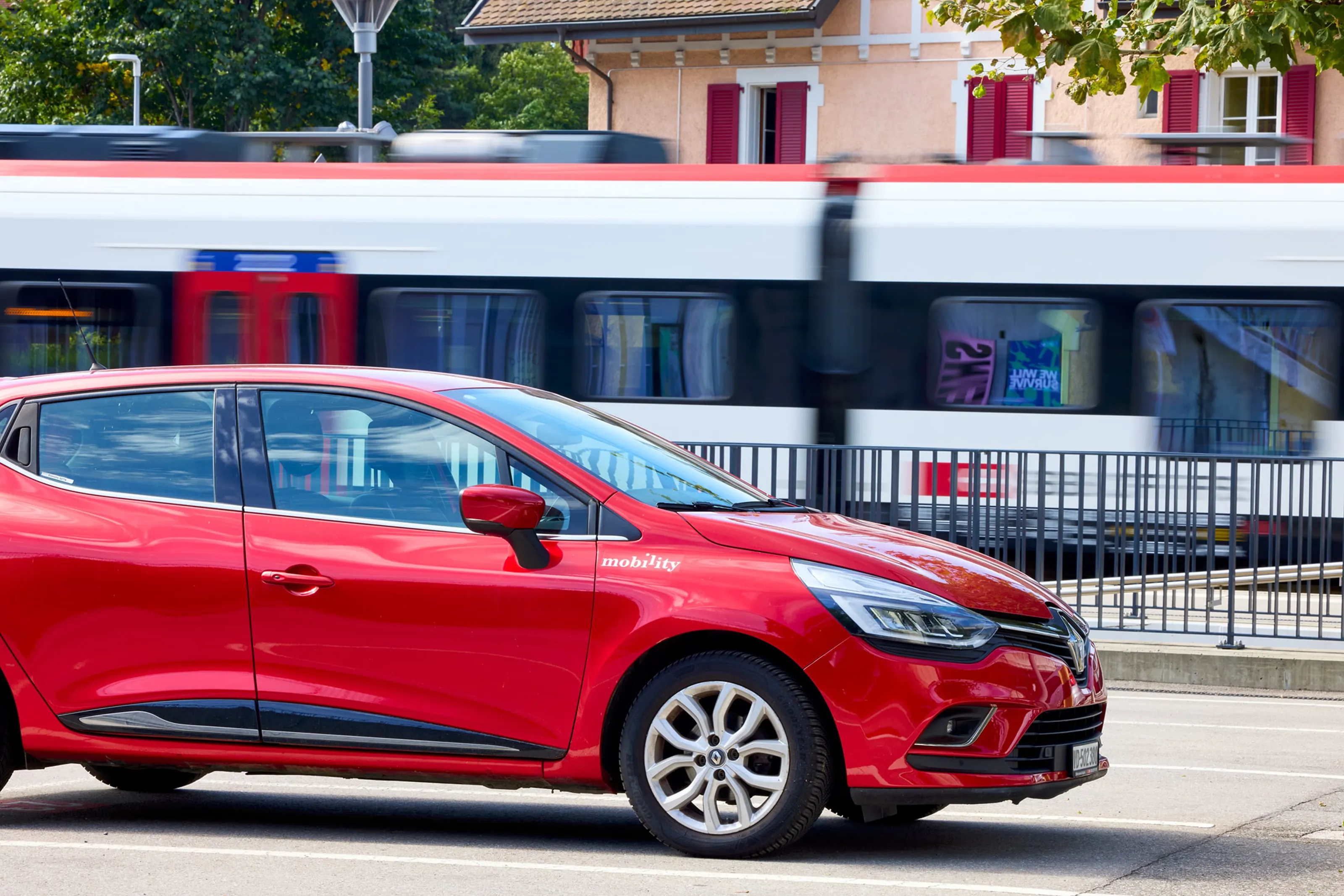
Red car sharing car driving along a road while an SBB S-Bahn train passes by in the background.

What’s an ideal solution for business appointments? Going by train first, then using a Mobility car for the last part.

2-in-1 account with employee benefit

The new model allows employees to use Mobility for business and private purposes via the same access point. Instead of two separate logins, there is one personal access method. Similar to a public transport app, you can choose between business and private use before your journey. Business journeys are billed to the company and private journeys to the individual person. The company only sees business journeys.

This approach opens up new opportunities for companies. If employees are entitled to use Mobility for business journeys, they also benefit from attractive terms for private use – with no additional basic fees. Jeannine Britschgi, Project Manager at Mobility, says: “If the company opts for mobilityPLUS, employees can also travel privately at the best rates – the monthly fee of CHF 9.90 is free. This makes Mobility both a work tool and a real benefit for the employees.”

«We add real value as an employer, as our employees benefit from a diverse fleet of vehicles.»
Dinesh Rajakaruna – ADMINISTRATIVE DIRECTOR OF GRAUBÜNDEN UNIVERSITY OF TEACHER TRAINING

University of Teacher Training is a firm believer

This is also underlined by Dinesh Rajakaruna, Administrative Director of Graubünden University of Teacher Training. “Thanks to the new subscription model, private and business journeys can be easily separated. At the same time, we add real value as an employer, as our employees benefit from a diverse fleet of vehicles.”

The straightforward onboarding is another particularly attractive feature: “We can also include employees and interns in the mobility offer quickly and at short notice and without any major administrative hassle,” says Dinesh Rajakaruna. “Mobility is used extensively in our day-to-day work – from internships at schools in Graubünden and the neighbouring cantons to other business trips, such as transporting 3D printers. These devices are used in different schools in connection with projects and have to be transported easily, regularly and at short notice.”

Man unloading luggage from the boot of a red car in front of a stone bridge.

Making sustainable impact visible

As business mobility evolves, the focus is also shifting to its impact. It is becoming increasingly important for companies to be able to understand the impact of their mobility – for example in the context of sustainability reporting. “Today, more and more companies have to disclose the emissions caused by their mobility,” says Roland Beyeler, who is responsible for sustainability analyses at Mobility. “By utilising car sharing, companies can sustainably reduce their emissions from corporate mobility.”

Mobility is already providing initial carbon footprint assessments for this purpose. At the same time, the company is working on expanding its carbon statement. In future, this tool will enable companies to disclose the emissions generated by the utilisation of Mobility vehicles. The carbon statement will be integrated into the Mobility business portal for companies by 2027.

Step by step into the new world of Mobility

The 5'700 or so business customers are gradually being transferred to the new Mobility model. The advancement of business mobility shows how Mobility is constantly adapting its offers: geared towards the everyday lives of users, open to new needs and with a view to sustainable progress.

Mobility is one of the first MoveSmart companies

The MoveSmart initiative aims to make business travel and commuting – i.e. corporate mobility – more sustainable. At its launch, 13 companies with more than 100'000 employees signed the initiative’s charter. Mobility is one of them and is committed to consistently promoting sustainable forms of mobility within the company. Over the next two years, 500 more companies are expected to join.